
How Do You Choose a High-Quality Matcha?
Matcha has become one of the most ordered drinks at cafes across San Francisco, and the range of quality available is enormous. You can pay three dollars for a matcha latte at a convenience store or fifteen dollars for a ceremonial grade preparation at a specialty cafe, and both will be green, and both will taste like it in the loosest sense of the word. But the experience, the flavor, the color, the texture, and what that powder actually does for your body will be completely different.
Knowing how to tell good from poor quality changes everything about how you buy it, order it, and drink it. This guide covers every meaningful indicator of quality so you can make informed decisions whether you are shopping for matcha to use at home or looking for the real thing at a good SF cafe or San Francisco brunch spot.
The market has expanded faster than consumer education about it. A decade ago, this powdered green tea was a specialty ingredient found mainly in Japanese grocery stores and high-end tea shops. Today it is on the menu at virtually every artisan coffee Bay Area cafe and most San Francisco restaurants that take their drinks seriously. That growth is positive, but it has also flooded the market with products that use the name while delivering a fraction of the quality, flavor, and health benefits that genuine matcha provides. Understanding what separates the two is not complicated once you know what to look for.
Where Matcha Comes From and Why Origin Matters
Quality begins in the field, long before the powder reaches your cup. All matcha comes from Camellia sinensis, the same plant that produces green tea, black tea, and white tea. What makes it distinct starts with the cultivation method and the specific growing region.
Japan is the world standard for production, and within Japan, a handful of regions are recognized for producing the highest quality leaves. Uji, in Kyoto Prefecture, is the most historically significant and widely recognized. Uji has been produced for centuries and is associated with the most refined ceremonial tea traditions in Japan. The soil, climate, and centuries of accumulated agricultural knowledge in this region produce leaves with exceptional flavor complexity, deep color, and high amino acid content. Other respected regions include Nishio in Aichi Prefecture, Yame in Fukuoka, and Kagoshima in the south, each with slightly different flavor profiles shaped by their geography.
Matcha produced in China is also widely available and significantly cheaper than Japanese varieties. Chinese production varies considerably in quality, and while some producers make genuinely good powder, the overall standard for ceremonial grade is much higher in Japan. The processing methods, shade-growing techniques, and quality controls that Japanese producers have refined over centuries are not uniformly matched by Chinese producers. For casual culinary uses like baking or blending into smoothies, the Chinese variety can be appropriate. For drinking as a latte or whisked preparation where flavor and color are the point, Japanese origin is the reliable choice.
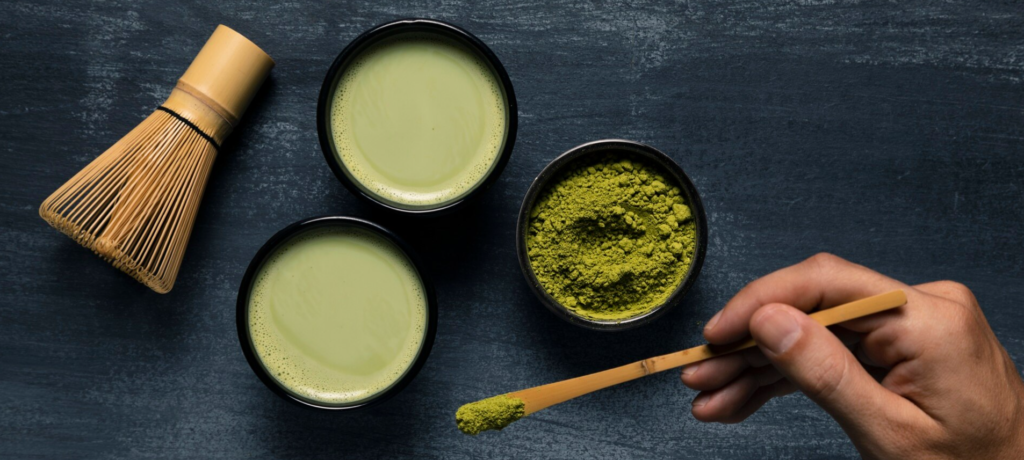
The shade-growing process is the foundation of quality and cannot be skipped or shortened without significantly affecting the final product. Roughly three to four weeks before harvest, the plants are covered with shade cloth that blocks most sunlight, typically around 90 percent. This triggers a stress response in the plant. It produces more chlorophyll to absorb the limited available light, more L-theanine to support that process, and deeper, more complex flavor compounds. The leaves that grow under shade are darker, softer, and more nutritionally dense than those grown in full sunlight. They are also more labor-intensive to grow, which is one reason why quality matcha is more expensive than lower-grade alternatives.
After shading, only the youngest, most tender leaves from the top of the plant are hand-picked. These young leaves are called tencha before they are processed into the finished powder. They are steamed immediately after picking to stop oxidation and preserve the vivid green color and fresh flavor.
Then they are dried, and critically, the veins and stems are removed before grinding. The remaining leaf material is ground slowly using stone mills into the fine powder you whisk into your cup. The grinding process must be slow to avoid heat from friction, which would damage the delicate aromatic and nutritional compounds in the leaf. A single stone mill produces only about 30 grams per hour. This is another reason genuine, high-quality matcha cannot be cheap.
The Key Quality Indicators You Can Actually Observe
Once you understand where quality comes from, the next step is knowing how to evaluate it yourself. There are several indicators you can assess with your eyes, nose, and palate, and none of them require any special equipment.
Color is the most immediate and reliable visual indicator. High-quality matcha is a vivid, saturated green, often described as bright or jewel-like. The green should be intense and uniform, without any yellowing, browning, or dullness. The depth of color comes directly from the chlorophyll content, which is determined by how long the plants were shaded, the quality of the growing region, and how recently the powder was ground.
When it has been sitting on a shelf too long, exposed to light or air, the chlorophyll degrades and the color shifts toward olive green, yellowish green, or even brownish green. A faded color is the clearest sign that what you are looking at is either low quality or old, and both mean reduced flavor and reduced health benefits.
The texture of the powder tells you something important as well. High-quality matcha is ground to an extremely fine consistency, so fine that when you press it between your fingers it feels smooth rather than grainy. Lower grade versions are often ground less finely, which results in a grainier texture that does not whisk as smoothly into water or milk and leaves a slightly gritty sensation in the finished drink. The fineness of the grind affects both how well the powder suspends in liquid and how the flavor compounds are released as you drink it.
Smell is an underused quality indicator but a very informative one. Fresh, high-quality matcha has a clean, grassy, slightly sweet aroma with a pleasant umami depth. It should smell like fresh vegetation, not stale, musty, or flat. If you open a tin and it has little to no aroma, or if the smell is unpleasant, that is a reliable sign of age or poor quality. The aromatic compounds are volatile, meaning they dissipate over time and with exposure to air. A fresh, recently opened, properly sealed tin will always smell more alive and complex than powder that has been sitting open for weeks.
Taste is the final and most complete indicator. High-quality matcha, particularly ceremonial grade, has a balanced flavor that is simultaneously vegetal, sweet, slightly bitter, and rich with umami. The sweetness comes from the amino acids, particularly L-theanine, that develop during the shading process. The umami is savory and satisfying.
The bitterness should be mild and pleasant rather than sharp or harsh. When you whisk ceremonial grade powder with water at the right temperature and drink it straight, it should feel smooth and coating in the mouth rather than thin and astringent. Low-quality versions taste predominantly bitter, often with a grassy or straw-like flavor and very little sweetness or depth. When mixed into a latte with milk, some of these differences are softened, but the fundamental quality gap remains noticeable in the finish.
Grades and When to Use Each One
The powder is generally divided into two broad categories: ceremonial grade and culinary grade. These are industry terms rather than formally regulated classifications, but they are widely used and helpful for making purchasing decisions.
Ceremonial grade matcha is made from the youngest leaves harvested at the first picking of the season, which is called the first flush or ichibancha in Japanese. These leaves have the highest concentration of L-theanine, the most vivid color, and the smoothest, most complex flavor. This grade is intended to be consumed straight, whisked with water in the traditional way or made into a pure latte without additional flavoring.
The flavor is refined enough to drink on its own without milk or sweetener, though many people enjoy it with milk as well. This is the grade you want if you are drinking for flavor and health benefits and if you are paying for a quality drink at a good specialty cafe.
Culinary grade covers a wide range of lower-tier products made from older leaves, later harvests, or leaves that include more stem and vein material. Within this category there are subcategories used by professionals, including ingredient grade for baking and blending, latte grade for mixing with milk, and kitchen grade for things like smoothies or cooking applications where the flavor is supporting rather than starring. Culinary grade tends to be more bitter and less vibrant in color, which is why it works better when other ingredients are present to balance it. For home baking, cooking, or blending into a protein smoothie, this grade is perfectly appropriate and significantly less expensive than the ceremonial variety.
A third category, sometimes called premium grade or select grade, sits between ceremonial and culinary and is often the sweet spot for daily lattes at home. Premium grade matcha has good color and flavor, is smoother than culinary grade, and is priced more accessibly than true ceremonial. Many good SF cafes and specialty coffee San Francisco operations use this tier for their lattes because it produces excellent results in a milk-based drink without the cost of using full ceremonial grade for high-volume service.
The grade system also intersects with harvest timing. First flush, harvested in spring, is always the highest quality because the plants have been resting through winter and the new growth is particularly tender, sweet, and nutrient-dense. Second flush and later harvests produce leaves that are slightly older, tougher, and more bitter. Knowing when your matcha was harvested is relevant if you are buying premium or ceremonial grade, and reputable producers will include harvest information on their packaging.
Packaging and storage tell you a great deal about how seriously a producer or retailer takes their product. Light degrades chlorophyll and aromatic compounds, so the powder should always be packaged in opaque or dark containers that block light exposure. Air causes oxidation, so the container should be resealable and ideally vacuum-sealed or nitrogen-flushed. It should also be stored away from heat and strong odors, as the finely ground surface area absorbs surrounding smells easily.
Good packaging will also include the harvest date or a best-by date, the region of origin, and ideally the cultivar or variety of tea plant used. When you cannot find this information on a product, it is usually because the producer does not want you to know it, which is itself informative.
At Doppio Coffee & Brunch on Mission St in San Francisco, the matcha on the menu reflects the same commitment to quality that runs through the Lavazza espresso program and the seasonal ingredients used across the all-day brunch menu. The cozy stylish interior on Mission St is the kind of space where drinking a well-made latte feels like an intentional choice rather than an afterthought, and the quality of what goes into the cup supports that experience. For anyone exploring Bay Area eats, building a San Francisco foodie guide, or simply looking for a reliable SF brunch spot where the drinks are made with real care, the drinks program at Doppio is worth experiencing.
When you know what high-quality matcha looks, smells, and tastes like, you stop settling for the dull, bitter versions that much of the market offers. You start noticing the difference between a latte made with vivid, fresh ceremonial grade powder and one made with whatever was cheapest on a wholesale site. That knowledge makes you a better consumer and a more satisfied drinker, and it changes what you reach for when you are looking for a good cafe near you or deciding what to order at a San Francisco brunch spot on a slow weekend morning.